
Fiji health

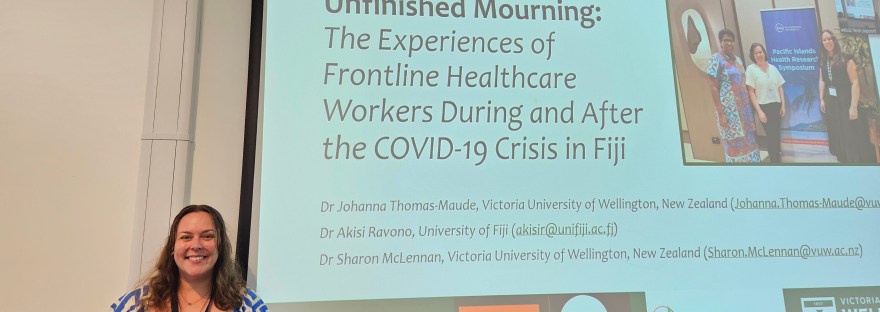
Difficult deaths, unfinished mourning: The experiences of frontline healthcare workers during and after the COVID-19 crisis in Fiji

Presentation: Thomas-Maude, J., Ravono, A., & McLennan, S. (2025, June 27). Difficult deaths, unfinished mourning: The experiences of frontline healthcare workers during and after the COVID-19 crisis in Fiji [Paper presentation]. DSA Conference 2025, Bath, U.K.

Abstract

The Covid-19 pandemic underscored the vulnerabilities of health systems in low- and middle-income countries, with Fiji reporting the highest pandemic-related mortality rate in the Pacific by late 2021.  Healthcare workers (HCWs) were at the frontlines of this crisis, experiencing the double burden of surging patient deaths in under-resourced settings, while struggling to manage personal loss and heightened familial responsibilities.  This professional and personal grief was compounded by chronic workforce shortages and challenging working conditions that were exacerbated by the Covid-19 pandemic.  With the health system under extreme pressure, HCWs assumed new roles beyond clinical care, including preparing food, sterilising hospital wards, reporting breaches in Covid-19 restrictions, and preparing the deceased for burial.

This paper presents preliminary findings from a case study investigating the experiences of HCWs who worked during the pandemic.  In early 2025, group talanoa (discussion) sessions were conducted with HCWs across Fiji to explore their changing roles.  HCWs described the emotional weight of caring for dying patients who were not permitted to have family present, the disruptions to deeply embedded cultural traditions of mourning and farewelling the dead, and the ongoing emotional scars of the pandemic – which are still raw almost four years after the height of the crisis in Fiji in 2021.

This paper contributes to broader discussions on death and crisis by illustrating how pandemic-induced disruptions to professional and cultural practices reshaped experiences of loss, care, and resilience.  Furthermore, the research highlights the need for more robust support systems for frontline workers navigating future crises.

Read more on the Fijian health system resilience project here.

Medical Migration

Not only patients waiting in line: Overseas-trained medical doctors in Aotearoa New Zealand

Presentation: Thomas-Maude, J. (2023, December 7). Not only patients waiting in line: Overseas-trained medical doctors in Aotearoa New Zealand. DevNet Development Studies Student Presentation Awards 2023, Palmerston North, New Zealand. https://youtu.be/JseVGmFpAi4

Abstract

Migrant doctors are indispensable to healthcare in Aotearoa New Zealand, making up 43% of our workforce.  Nevertheless, there are significant challenges to labour mobilities in this sphere.  The registration requirements for overseas-trained doctors and depend on the level of development of your country of training – something beyond the control of an individual doctor. 

Doctors from the Global North can generally practise upon arrival, and are considered highly-skilled migrants for immigration purposes, although they do often face lengthy regulatory obstacles before travelling to Aotearoa.  However, doctors who did not train in “comparable health systems” – most of whom are from the Global South – are generally unable to immigrate as highly-skilled migrants.  Nevertheless, they are required to pass several examinations and complete supervised work placements while residing in Aotearoa, in order to practise medicine.  There are significant wait times for the necessary examinations, and supervised placements are limited and prioritised for New Zealand medical graduates.  As a result, hundreds of migrant physicians, many of whom have demonstrated the required knowledge and clinical skill-base, are caught in a bottleneck and still cannot practise. 

This presentation provides a brief overview of the research background and findings, drawing on qualitative interviews, an online questionnaire and policy analysis to explore the differential experiences of individuals who trained in both the Global South and Global North.

Read more: Thomas-Maude, J. (2023). Mobility justice, capabilities, and medical migration: Medical licensing pathways for overseas-trained doctors in Aotearoa New Zealand. Australian Geographer, 54(4), 479-‌497. https://www.tandfonline.com/doi/full/10.1080/00049182.2023.2245620

voluntourism

Re-framing volunteer tourism: Cultural exchange in Peru and Fiji

Conference presentation: Thomas-Maude, J., & McLennan, S. (2023, October 10-13). Re-framing volunteer tourism: Cultural exchange in Peru and Fiji. ATLAS Annual Conference 2023, Bad Gleichenberg, Austria.

Abstract

This blending of short-term volunteering and development in volunteer tourism has been widely critiqued over the past decade, reflecting a tension between activities that are perceived as morally ‘good’ and activities that are considered to be morally insignificant, and a concern that volunteer tourism that involves volunteers from the global North working in the global South may be a form of (white) saviourism that increases the influence, reach and power of the global North under the guise of ‘making a difference’. As a step towards addressing these inequalities and paradoxes, voluntourism is often now conceived of as an ‘exchange’, whereby both volunteers and providers or recipients benefit from the relationship. This involves a focus on relationships, mutual understanding and respect for different cultures and knowledge systems, while moving away from discourses of ‘doing good’, helping and development.

In this presentation we explore the intersection of voluntourism and cultural exchange through qualitative case studies from Peru and Fiji. The Peruvian study focussed on a small, volunteer English teaching agency that operates in both state and private schools in Lima, while the Fijian study focussed on the Fijian office of an international, for profit, youth volunteering agency. While very different, these agencies and their volunteers emphasised cultural exchange as a key purpose for volunteering, and the studies highlight the ways in which cultural exchange was used as a means of re-framing the role of volunteer tourism and circumventing the language of ‘development’. Both were somewhat successful in this regard and there was potential for these encounters to increase mutual understanding and respect. However, the research also showed that emphasising cultural exchange does not automatically encourage volunteer-tourists to face difficult questions regarding inequalities and differences across cultures, and that the context of significant inequality and difference, alongside the commodification of the volunteering experience, undermines the claims to equal exchange. The studies therefore raise some significant questions about justice, equity, and cultural understanding and we argue that voluntourism, when undertaken – as it often is – by volunteers from the global North working in the global South remains a highly inequitable, neo-colonial practice. Reframing volunteer tourism as cultural exchange may further mask and even perpetuate this injustice and inequality.

Read more: McLennan, S. & Thomas-Maude, J. (2023). Othering or authenticity: Volunteer tourism and cultural exchange. Journal of Hospitality and Tourism Management, 56. https://doi.org/10.1016/j.jhtm.2023.06.020

Thomas-Maude, J., McLennan, S., & Walters, V. (2021). Cultural exchange during English-Language Voluntourism (EVT) in Lima, Peru: A postcolonial analysis. Journal of Language, Identity & Education, 1-16. https://doi.org/10.1080/15348458.2021.1991802

McLennan, S. J. (2019). Global encounters: Voluntourism, development and global citizenship in Fiji. The Geographical Journal, 185(3), 338-351. https://doi.org/10.1111/geoj.12318 

Thomas-Maude, J. (2019). “They come because they know the teachers are gringos” : A post-colonial exploration of the perceived value of volunteer English teaching in Lima, Peru [Masters Thesis, Massey University]. https://mro.massey.ac.nz/handle/10179/15743